

NanoATi · Treatment comparison
NanoATi vs tendon repair surgery
NanoATi supports selected tendon that remains continuous. Surgery restores tissue that needs mechanical reattachment or reconstruction.
 Reviewed byProfessor Paul Lee MBBch, FRCS (Tr & Orth), PhDCartilage and joint preservation expertise
Quick answer
The decision turns on tendon continuity and function. NanoATi cannot reattach a complete rupture or detached tendon. Surgery should not be automatic for every tendinopathy or partial tear when useful continuity remains.
Verified across three networks
Trusted by patients on Doctify, Google and Top Doctors
The decisive distinction
Viable continuity and mechanical failure need different treatment
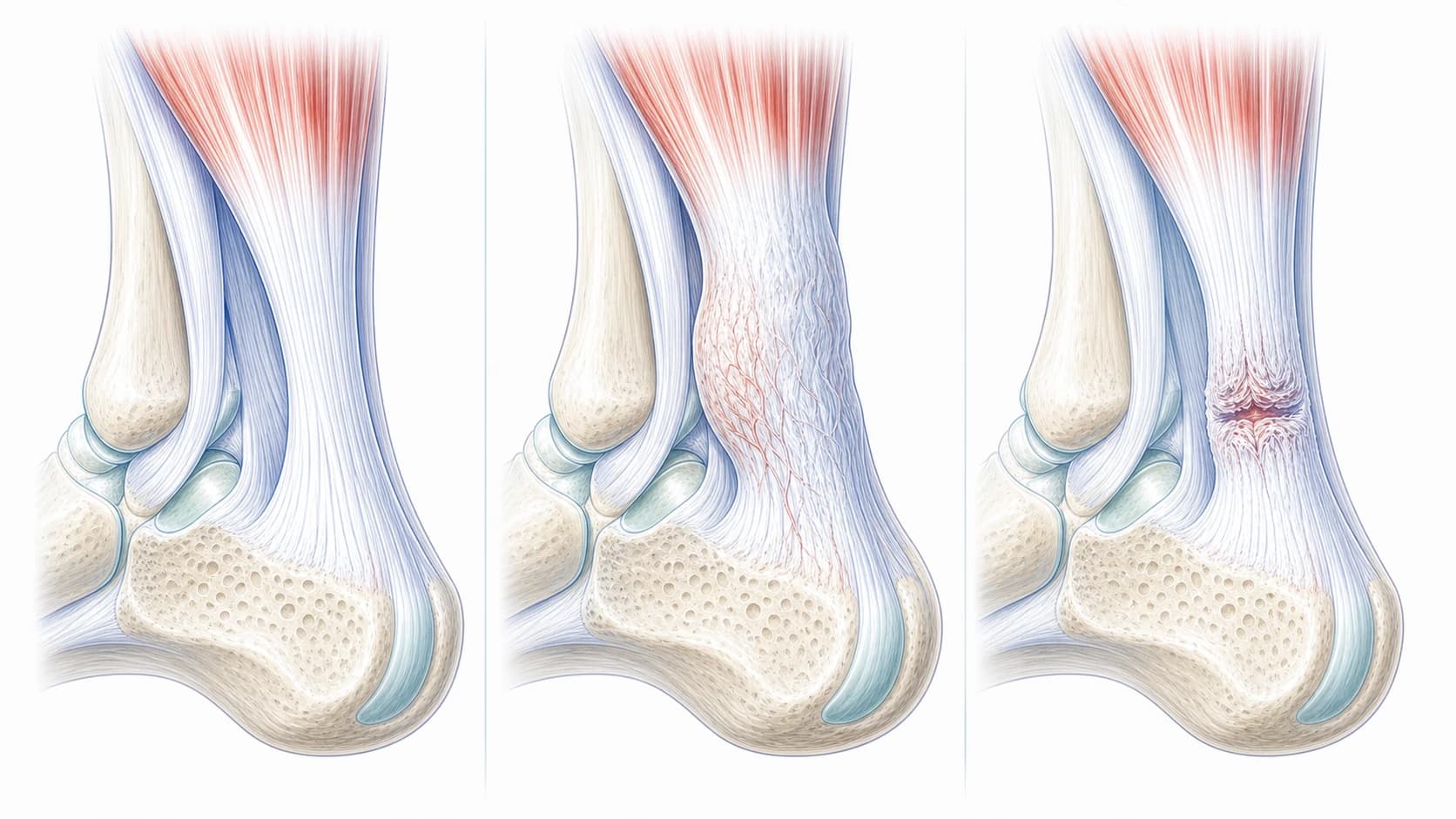
NanoATi may be considered when damaged tendon remains continuous and capable of being progressively loaded. Surgery is used when tissue must be reattached, reconstructed or mechanically restored.
Complete rupture is the clearest example, but the decision also considers retraction, tear depth, strength, tendon involved, trauma, chronicity and the patient's functional goal.
When surgery becomes credible
Repair is about restoring connection and force transmission
A tendon functions as a mechanical cable between muscle and bone. When that connection is lost, symptoms are only part of the problem: force can no longer travel normally through the unit.
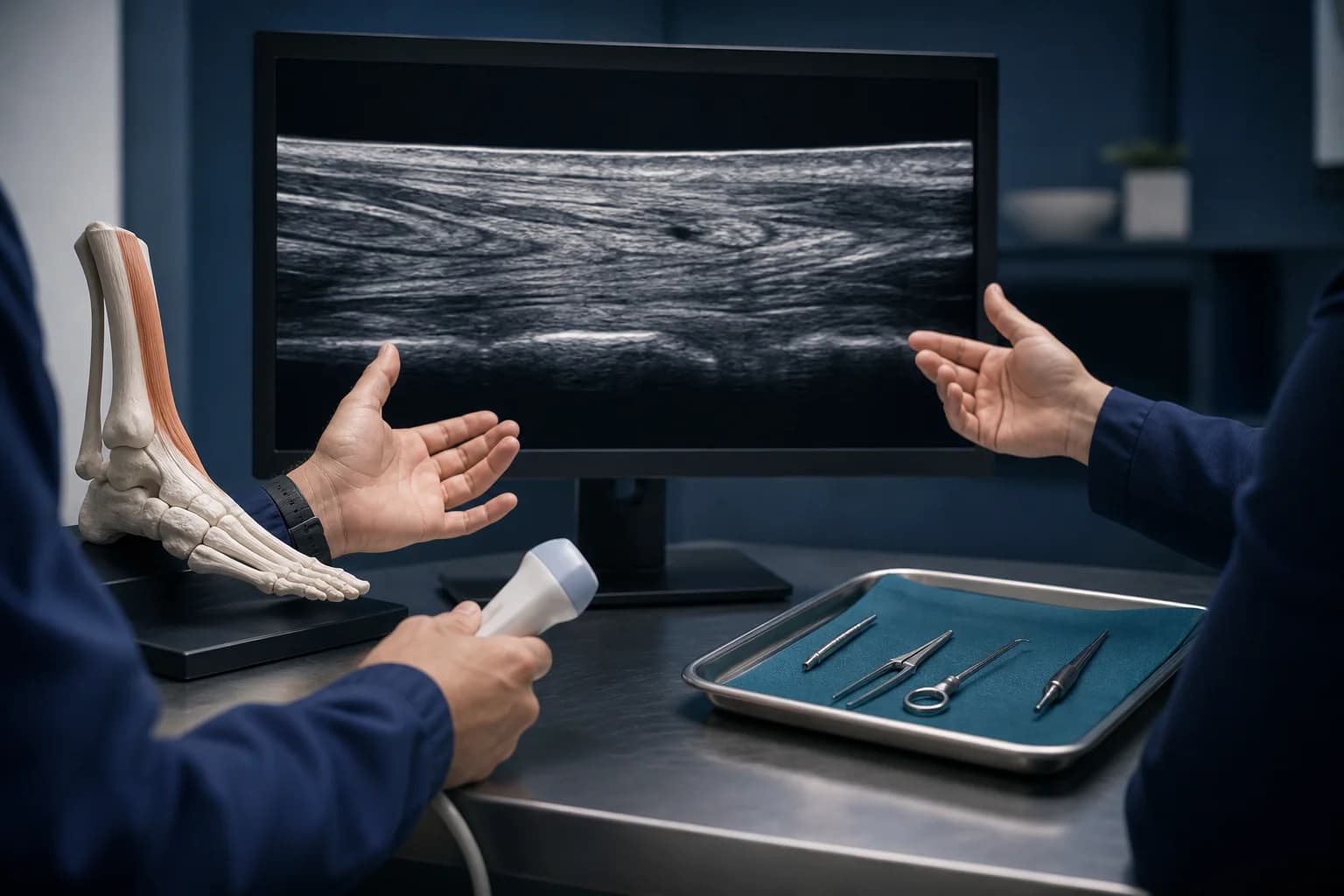
Surgical thresholds vary. An acute Achilles rupture, detached rotator cuff or patellar tendon failure cannot be discussed as though they were the same operation. Individual anatomy, age, demand and non-operative alternatives still matter.
Recovery trade-off
Both routes require rehabilitation, for different reasons
Surgical repair needs protection while fixation and tissue heal. NanoATi avoids an operation but still requires progressive loading to rebuild capacity. Neither route offers an instant return to full demand.
The better pathway is the one that addresses the diagnosed structure with proportionate risk—not automatically the less invasive or more intervention-heavy option.
Side-by-side
Support viable tendon or repair failed tendon?

NanoATi and tendon surgery questions
Can NanoATi avoid surgery after a complete rupture?
It cannot reconnect a complete rupture. Some ruptures have non-operative pathways, but that decision is a structured rupture-management plan rather than NanoATi substituting for repair.
Does a partial tear always need surgery?
No. Tear depth, tendon, strength, symptoms, progression and response to rehabilitation all matter. Many partial tears are managed non-surgically.
Which route has the quicker recovery?
NanoATi avoids surgical wound and fixation healing, but tendon capacity still takes time. Surgery usually brings more protection, although timelines vary substantially by tendon and repair.
Can biology be used around a surgical repair?
Biological adjuncts may sometimes be considered within a separate surgical plan. That is different from stand-alone NanoATi and should be described separately.
Still have more specific concerns?
Free Discovery CallOptions that our doctors may discuss include NanoACi, ChondroFiller, Mytocel MSK, joint replacement, established conservative care or surgery, depending on examination and imaging.
Clarify whether the tendon is continuous
Professor Lee can define the tear, strength loss and functional requirement before discussing rehabilitation, injection or repair.